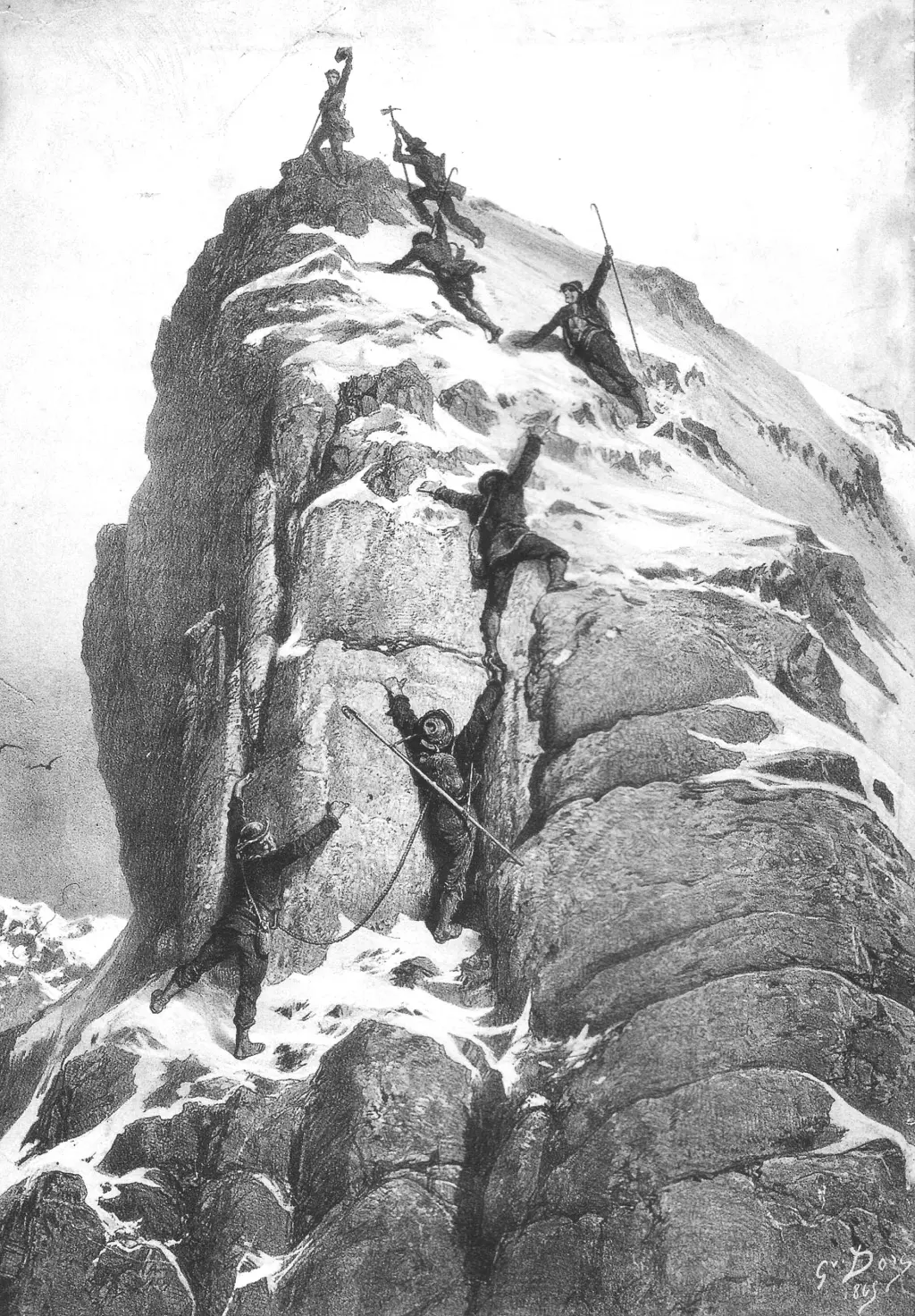
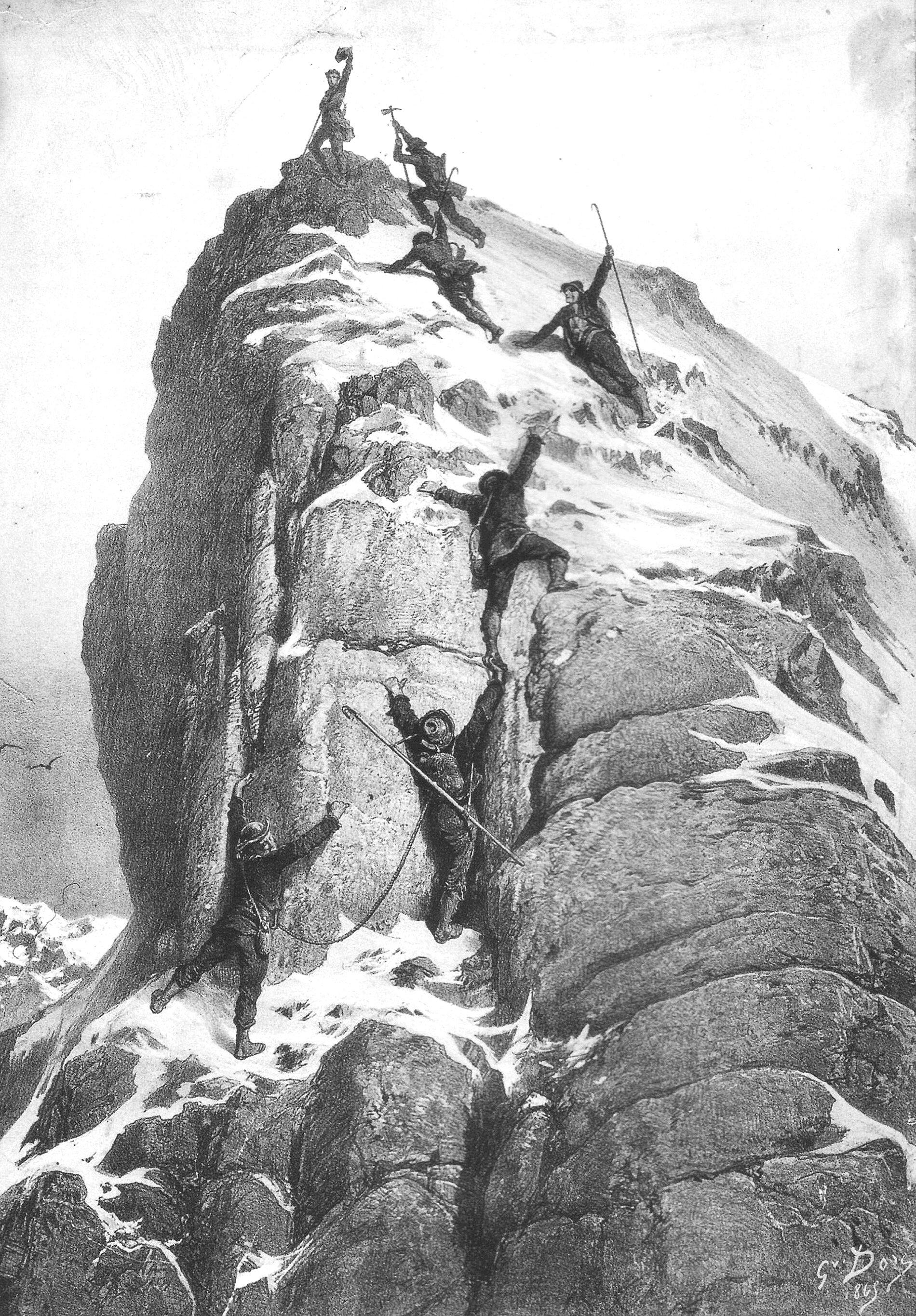
The Matterhorn stands on the border between Switzerland and Italy and dominates the surrounding Alpine landscape. Before 1865, it remained unclimbed despite repeated attempts. Its steep faces, unstable rock, and sharply pointed summit made it one of the most feared peaks in Europe.
The Matterhorn Tragedy of 1865: The Ascent That Changed Mountaineering Forever
The Matterhorn Before 1865
The Matterhorn stands on the border between Switzerland and Italy and is one of the most recognizable mountains in the Alps. Its sharply pointed summit rises above the surrounding valleys and can be seen from many parts of the region.
During the middle of the nineteenth century most major Alpine peaks had already been climbed. However, the Matterhorn remained untouched. Its steep rock faces, unstable sections of stone, and exposed ridges made it one of the most intimidating mountains in Europe.
Climbers of that period were already exploring the Alps actively. This period later became known as the Golden Age of Alpinism. During those years many first ascents were achieved, and mountaineering was gaining popularity among European explorers and adventurers.
Because the Matterhorn had resisted every attempt, it became the final great challenge of that era. Reaching its summit promised both recognition and historical importance.
Edward Whymper and the Race to the Summit
Edward Whymper and his principal rival Jean-Antoine Carrel, whose competing attempts defined the race to climb the Matterhorn. Image credit: Alpine Club Archive / Wikimedia Commons
British climber Edward Whymper first attempted to climb the Matterhorn in 1861. Over the next four years he returned repeatedly, studying the mountain and searching for a possible route to the summit.
Whymper was not alone in his ambition. Italian guide Jean-Antoine Carrel also believed the mountain could be climbed. Carrel focused on the Italian side of the peak, attempting to reach the summit by the Lion Ridge.
This created an informal rivalry between the two climbers. Both men were determined to reach the summit first, and by the summer of 1865 both teams were preparing for another attempt.
The Final Expedition (July 1865)
On 13 July 1865, Edward Whymper left the village of Zermatt with a team of climbers and mountain guides. The group planned to attempt the ascent by the Hörnli Ridge on the Swiss side of the mountain.
Members of the climbing party
Edward Whymper – British climber
Charles Hudson – British mountaineer and experienced alpinist
Lord Francis Douglas – British aristocrat and climber
Douglas Robert Hadow – young British climber
Michel Croz – highly skilled French mountain guide
Peter Taugwalder (father) – Swiss mountain guide
Peter Taugwalder (son) – Swiss mountain guide
The Hörnli Ridge appeared to offer the most practical route toward the summit. Although still steep and exposed, it allowed climbers to progress gradually upward along a ridge rather than attempting the nearly vertical faces of the mountain.
The First Ascent of the Matterhorn
On the morning of 14 July 1865, the team continued climbing toward the summit. The weather was stable and the group made steady progress along the ridge.
Eventually the climbers reached the summit of the Matterhorn. From the top they were able to see Jean-Antoine Carrel and his team climbing far below them on the Italian side of the mountain. Whymper's group had reached the summit first.
The climbers spent only a short time at the top. Like modern mountaineers, they understood that the descent was often more dangerous than the ascent. After taking in the view, the group began preparing for the return to the valley.
The Fatal Descent
During the descent the climbers were connected by ropes in a single line. This method allowed climbers to help arrest a fall if someone slipped on the steep sections of the mountain.
The order of the rope team was as follows:
Michel Croz
Douglas Robert Hadow
Charles Hudson
Lord Francis Douglas
Edward Whymper
The two Taugwalder guides followed behind.
While descending a steep section of rock, Douglas Hadow slipped. Michel Croz attempted to stop the fall but was pulled off balance. The sudden movement caused Hudson and Douglas to lose their footing as well.
The rope connecting Douglas to Whymper broke under the strain. As a result, the four climbers above the break fell down the face of the mountain.
Fatalities of the Matterhorn Accident
The fall carried the climbers more than one thousand meters down the mountain. All four died during the accident.
Michel Croz – French mountain guide
Douglas Robert Hadow – British climber
Charles Hudson – British climber
Lord Francis Douglas – British climber
Edward Whymper and the two Taugwalder guides remained attached to the remaining rope and were able to stabilize themselves on the mountain. After the accident they carefully continued the descent and eventually reached Zermatt safely.
Investigation and Public Reaction
The tragedy attracted immediate attention throughout Europe. Mountaineering was becoming popular at the time, and newspapers followed the story closely.
A Swiss investigation examined the accident. The inquiry concluded that the fall began when Douglas Hadow slipped during the descent. The rope that broke was weaker than the others used by the team, which contributed to the accident.
The investigation determined that the incident was a climbing accident rather than a deliberate act or criminal negligence.
Historical Significance
The accident on the Matterhorn had a lasting impact on mountaineering. The tragedy reminded climbers that reaching the summit was only part of the challenge and that the descent could be equally dangerous.
After the event, climbers began paying greater attention to equipment and team organization. Stronger ropes, more careful route planning, and improved climbing techniques gradually became standard practice.
For many historians, the tragedy also marked the symbolic end of the Golden Age of Alpinism.
Rob Hall remained high on the mountain assisting Hansen. Hansen was severely exhausted and struggling to descend. Scott Fischer also slowed dramatically during descent and eventually stopped moving.
The crossings were not single continuous marches. They were a series of calculated movements from one known source of life to the next. Each arrival at a functioning well brought visible relief. Each departure meant committing again to uncertainty.
Ernesto Guevara de la Serna was born in 1928 in Rosario and raised primarily in Córdoba and later Buenos Aires. His family belonged to Argentina’s educated middle class and encouraged independent thinking